 English
  فارسی
فارسی  English
  العربية
 Cart
0 Toman

AMH is a Marker of Egg Count, Not Quality:
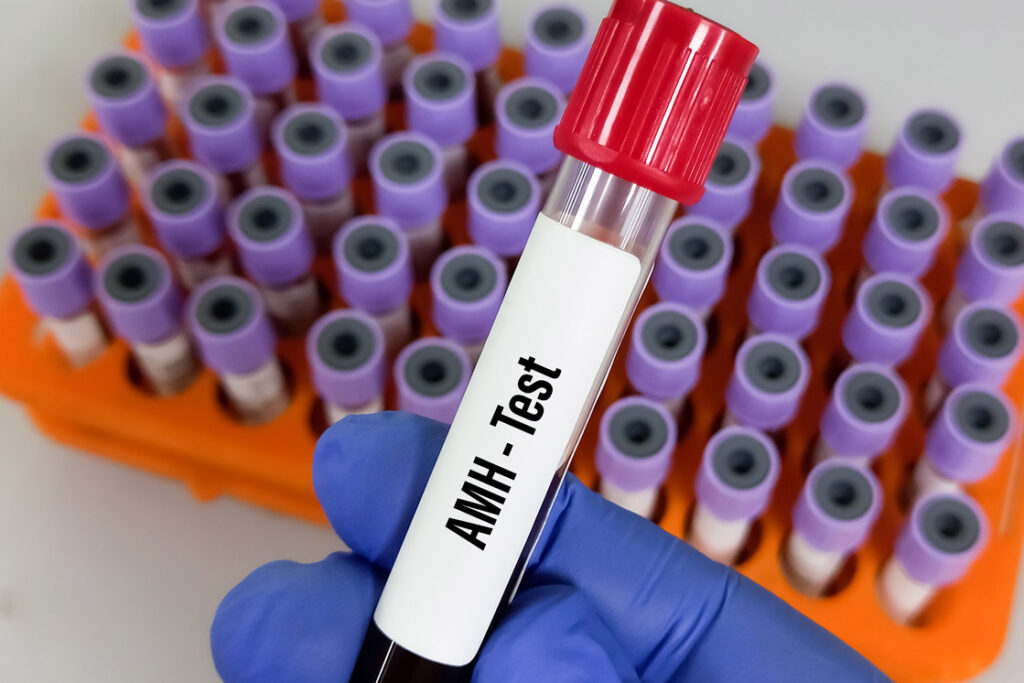
An AMH blood test indicates how many small follicles remain in the ovaries, according to ACOG and ESHRE recommendations. It does not provide information about egg quality or predict natural pregnancy rates in women with regular cycles.
Age-Specific Percentiles are Important:
It is vital to compare results with those of women of the same age, as AMH levels naturally decline with age. For instance, the median AMH at age 25 is 3.03 ng/mL, which drops to 0.31 ng/mL at age 44.
Birth Control Lowers AMH Temporarily:
Combined oral contraceptives (COCs) may cause a temporary reduction in AMH levels. AMH generally increases by about 53% after discontinuation of the medication. It’s advisable to wait two months after stopping birth control to obtain an accurate AMH measurement.
Vitamin D is Not a Booster for AMH:
Vitamin D is crucial for reproductive health, yet studies have shown that Vitamin D supplementation does not raise AMH levels.
AMH Testing in Boys:
Anti-Müllerian hormone is produced by Sertoli cells in male babies and children. AMH testing helps clinicians differentiate between undescended testicles and immature testes, and it can be used to diagnose several disorders of sex development.
The Anti-Müllerian Hormone (AMH) test is a widely used blood test to evaluate reproductive health, but it is often misunderstood. A low AMH level can cause unnecessary concern, but it’s just one factor in your fertility story. This test will not predict your chances of getting pregnant naturally, but it will tell you about your ovarian reserve (how many eggs you have left) and not the quality of your eggs. AMH is an important marker for tailoring fertility treatments such as IVF, can be temporarily suppressed with birth control, and is useful in diagnosing some childhood male health conditions. In this guide, we explain what AMH measures, demystify AMH test interpretation, and help you feel confident about your results.
Anti-Müllerian hormone is a protein generated by the granulosa cells of tiny ovarian follicles. It is a member of the Transforming Growth Factor-beta (TGF-β) family. In laboratory settings, a high-quality [AMH assay kit] is routinely used for accurate measurement to prevent potential analytical errors.
Prevents Over-Recruitment of Follicles: AMH functions as a brake, preventing too many latent follicles from developing at once.
Regulates FSH Sensitivity: It decreases the sensitivity of growing follicles to Follicle Stimulating Hormone (FSH) so that the body can choose the optimal number of follicles to mature each cycle.
Stable Throughout the Cycle: Unlike FSH, LH, and estradiol, which vary over the menstrual cycle, AMH levels are stable; therefore, blood can be drawn any day of the cycle.
Having “low AMH” can be anxiety-provoking, but it is not a direct marker of infertility. AMH is beneficial to predict ovarian response to reproductive treatments such as IVF. This helps doctors decide what dose of medication to use to maximize the number of eggs retrieved, without causing overstimulation or a poor reaction.
It does not tell you egg quality, chromosomal health, or the chance of getting pregnant naturally if your cycles are regular. Age, but not AMH level, primarily dictates egg quality. So low AMH in a 28-year-old means she has fewer eggs, but they might be better quality than the eggs of a 42-year-old woman with the same quantity of AMH.
AMH levels should always be age-adjusted. The table below outlines the normal AMH levels by age (median values in ng/mL):
| Age Group (Years) | 5th Percentile | 25th Percentile | 50th Percentile (Median) | 75th Percentile | 95th Percentile |
|---|---|---|---|---|---|
| 25 – 27 | 0.95 | 1.98 | 3.03 | 4.55 | 7.82 |
| 28 – 30 | 0.78 | 1.62 | 2.54 | 3.90 | 6.85 |
| 31 – 33 | 0.54 | 1.25 | 2.01 | 3.15 | 5.60 |
| 34 – 36 | 0.32 | 0.85 | 1.48 | 2.42 | 4.45 |
| 37 – 39 | 0.15 | 0.48 | 0.92 | 1.65 | 3.10 |
| 40 – 42 | 0.05 | 0.22 | 0.51 | 1.02 | 2.05 |
| 43 – 44 | 0.01 | 0.09 | 0.31 | 0.65 | 1.35 |
Doctors look at where you fall within these ranges to assist with fertility planning and preservation (e.g., egg freezing).
Transient Suppression: The birth control pill will temporarily lower your AMH level and the number of visible follicles [1].
Recovery After Discontinuation: After stopping long-term use of COCs, AMH levels increase by about 53% and follicle count by 41% [1].
After discontinuing the pill, wait at least 2 months before testing; otherwise, you could be misdiagnosed with a reduced ovarian reserve [1].
Vitamin D is important for reproductive health (Vitamin D receptors are found in ovarian tissue), yet research shows no substantial change in AMH levels with Vitamin D supplementation [2]. Fixing a deficiency is good for overall health, but it won’t boost AMH or improve your egg reserve [2].
AMH is also vital in male development. It is produced by Sertoli cells in the male fetus and causes regression of the Müllerian ducts.
AMH testing in male infants with non-palpable testes can help differentiate between disappearing testis syndrome and the presence of functional testicular tissue [4].
In newborns with ambiguous genitalia or suspected Persistent Müllerian Duct Syndrome (PMDS), AMH is tested to evaluate Sertoli cell function [4].
The Anti-Müllerian Hormone (AMH) test is only one piece of the fertility puzzle. It can’t tell you when or if you will get pregnant naturally, and quick fixes like Vitamin D supplements can’t increase your hormone levels. However, it provides a clear, consistent picture of your ovarian reserve to help guide treatment decisions like IVF or fertility preservation with confidence [5].




0 Comment
Submit Comment